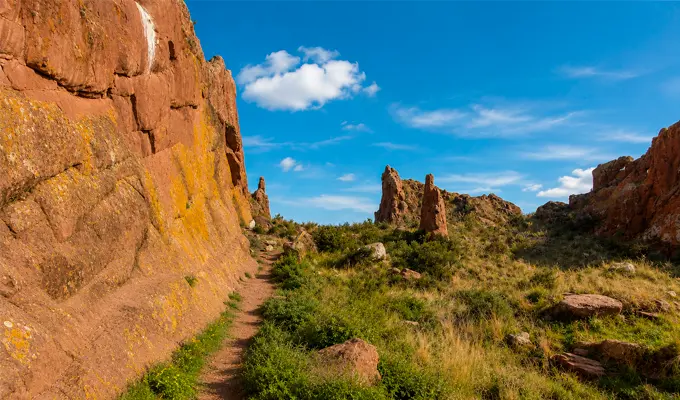
In the heart of the Puno Altiplano, surrounded by towering red rock formations and just a short distance from the majestic Lake Titicaca, lies one of Peru’s most mysterious and captivating landmarks: the Aramu Muru Gate, also known as the Hayu Marca Portal or the Gate of the Gods.
At first glance, it appears to be an impressive structure carved directly into solid rock. However, for those who visit, it is much more than that. For decades, this enigmatic site has fascinated archaeologists, travelers, and spiritual seekers drawn by the legends and mysteries surrounding it.
Although science has yet to unravel all of its secrets, Aramu Muru possesses a unique charm that blends ancient history, living folklore, and breathtaking natural scenery, making it an essential destination for anyone eager to experience the profound energy of the Andean Altiplano.
At first sight, the Aramu Muru Gate impresses visitors with its immense size. Measuring nearly seven meters (23 feet) high and seven meters wide, this monumental portal has been meticulously carved into a massive wall of red sandstone. At its center stands the iconic trapezoidal niche, a hallmark of Andean architecture, perfectly resembling a doorway that, intriguingly, leads nowhere, as it opens directly into the rock itself.
Rather than serving as a physical entrance to another chamber, archaeologists believe it was a sacred ceremonial site. Evidence suggests that ancient civilizations of the Altiplano carved this monument as a place of worship where rituals, offerings, and prayers honoring nature and spiritual forces were performed.
| Fact | Information |
| Location | Hayu Marca, Puno |
| Elevation | 3,900 m (12,795 ft) |
| Portal Height | 7 meters (23 ft) |
| Alternative Name | Gate of the Gods |
| Main Attraction | Rock-carved stone portal |
| Best Time to Visit | May to October |
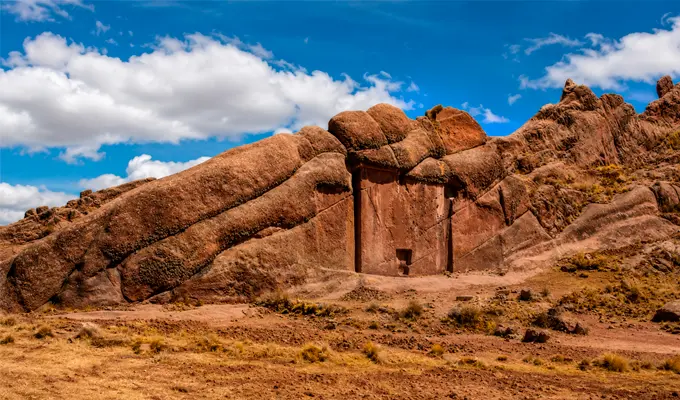
Reaching this mystical destination is an unforgettable experience. The portal is located in the community of Hayu Marca, within the district of Juli (El Collao Province), approximately 70 to 80 kilometers (43–50 miles) south of the city of Puno. It is surrounded by striking reddish rock formations and mountain landscapes overlooking the magnificent Lake Titicaca.
To help you plan your visit, here are the essentials: the site sits at an elevation of approximately 3,900 meters (12,795 feet) above sea level, in the heart of the Andean Altiplano. From downtown Puno, the journey takes between one and one and a half hours, making it an accessible day trip filled with spectacular scenery and a fascinating glimpse into Peru’s ancient cultural heritage.
One of the most fascinating aspects of Aramu Muru is that, to this day, historians and archaeologists have not been able to determine exactly who carved it or when it was created. It remains one of Peru's enduring archaeological mysteries.
What is known is that the Altiplano was home to powerful ancient civilizations, including the Pukara, Lupaca, the Aymara kingdoms, and later the Inca Empire. For this reason, researchers widely agree that this was never an ordinary place. Long before the Incas expanded across the Andes, these rock formations were already regarded as a sacred sanctuary, where different cultures gathered to honor their deities and connect with the spiritual power of the earth.
What truly surrounds this place with mystery is the legendary story of the priest from whom it takes its name: Aramu Muru.
According to oral tradition, during the turbulent arrival of the Spanish conquistadors, the wise priest fled Cusco carrying the most sacred treasure of his temple: a magnificent golden disk known as the "Key of the Gods". After a long journey across the Altiplano, he reached this enormous rock wall. There, he placed the golden disk into a small circular recess at the center of the portal. Miraculously, the stone opened, allowing him to pass into another dimension or sacred world from which he was never seen again.
Over time, this captivating legend has inspired travelers, mystics, and spiritual seekers from around the world, many of whom believe the monument is a genuine gateway to other realms. Although no archaeological evidence supports the story and it remains part of local folklore and popular belief, the legend undeniably adds a mystical atmosphere that makes standing before this monumental stone portal an unforgettable experience.
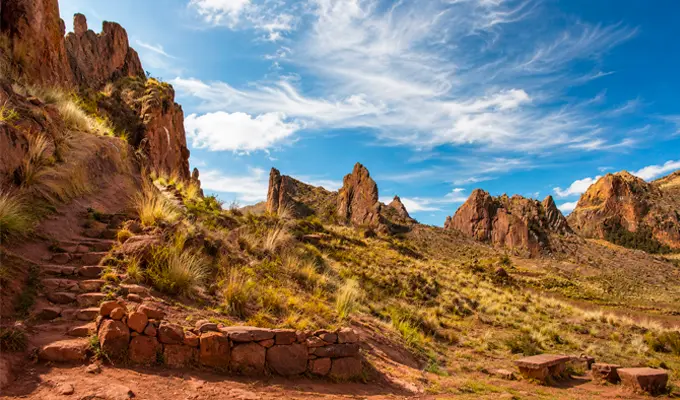
Standing before this remarkable monument, the first thing that captures your attention is the extraordinary precision of its craftsmanship. Every detail reflects the skill of its ancient creators. Here are its most striking features:
The greatest mystery, however, is that despite looking exactly like a doorway, the portal does not lead into any chamber or interior space. It is a doorway carved into solid rock that seemingly leads nowhere or perhaps somewhere beyond our understanding.
Over the years, Aramu Muru has become a magnet for travelers from around the world who are drawn by stories of spiritual energy, meditation, and unexplained phenomena.
Today, it is common to see visitors performing traditional Andean ceremonies of gratitude, seeking moments of quiet reflection, or simply immersing themselves in the profound peace offered by the breathtaking landscapes of the Andean Altiplano.
From a cultural perspective, the portal is respected as a sacred site deeply connected to the Andean worldview and the spiritual significance of the earth. Meanwhile, theories about interdimensional gateways belong to modern mysticism and popular belief. Although there is no scientific evidence supporting these claims, they undeniably add an aura of mystery and fascination that captivates everyone who visits.
Beyond the impressive stone portal itself, the surrounding area offers several attractions that make every step of the visit worthwhile:
If you're traveling from the city of Puno, reaching the site is relatively easy. You have several options depending on your travel style:
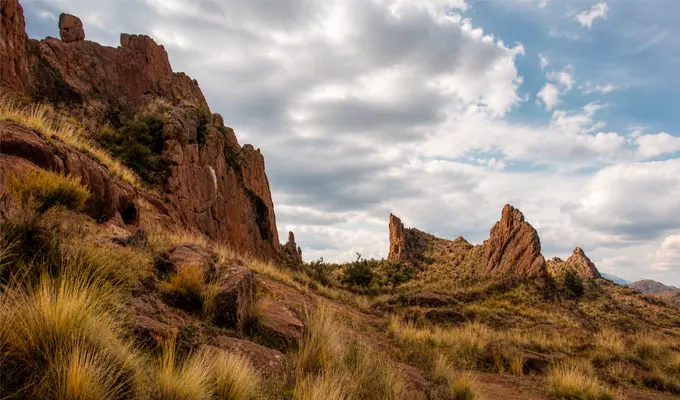
The dry season, which runs from May to October, is undoubtedly the best time to visit the Aramu Muru Gate. During these months, the Andean Altiplano offers its finest scenery, with brilliant blue skies, minimal rainfall, and ideal weather for outdoor exploration.
This is the perfect season to explore the site comfortably, enjoy breathtaking panoramic views, and fully appreciate the mystical atmosphere of this remarkable destination.
To make the most of your visit, keep these practical recommendations in mind:
Was the Aramu Muru Gate built by the Incas?
There is no conclusive archaeological evidence regarding its origin. Researchers believe the monument was carved and used by pre-Inca cultures of the Altiplano, such as the Lupaca or Tiwanaku civilizations, and was later adopted by the Incas as a sacred ceremonial site.
Why is it known as the "Gate of the Gods"?
The name comes from local legends and mystical traditions that describe the monument as a symbolic or sacred gateway to the realm of the Andean deities, known as Hanan Pacha.
Does the portal lead to a cave or hidden chamber?
No. It is a monumental structure carved directly into a solid rock face and does not lead to any cave, tunnel, or underground chamber.
Can it be visited year-round?
Yes. The site is accessible throughout the year. However, visiting during the dry season (May through October) offers the most enjoyable experience, with dry trails, clear skies, and excellent weather conditions.