Talking about the Caballitos de Totora means exploring one of the oldest stories of resilience and ingenuity in Peru. These are far more than simple boats—they are a legacy of more than 3,000 years that has withstood the test of time. Beyond their practical function, these reed watercraft have become a true symbol of identity, cultural resilience, and adaptation to the natural environment. In fact, they achieve something remarkable: they create an invisible connection between two fascinating yet very different worlds—the Altiplano of Puno and the beaches of Peru’s northern coast.
In the region of Puno, life is inseparable from the legendary Lake Titicaca, the highest navigable lake in the world. In this Andean corner of Peru, totora reeds are much more than an aquatic plant they are the foundation of local survival, culture, and economy.
| Key Point | Description |
| Ancient Origin | The Caballitos de Totora have a history spanning more than 3,000 years and were created by ancient pre-Inca civilizations. |
| Construction Material | They are made from totora reeds, a durable, buoyant, and biodegradable aquatic plant that is also used to build homes and floating islands. |
| Use on Lake Titicaca | They serve as a traditional means of transportation and fishing for the lake’s communities, especially the Uros people. |
| Tradition in Huanchaco | On Peru’s northern coast, the fishermen of Huanchaco continue to use them every day for artisanal fishing, preserving a tradition that dates back more than 2,000 years. |
| Cultural and Tourism Value | The Caballitos de Totora are an important symbol of Peruvian identity and a major tourist attraction in both Puno and the La Libertad region. |
| Living Heritage | They represent an ancestral legacy passed down from generation to generation and, in Huanchaco, they have been recognized as National Cultural Heritage. |
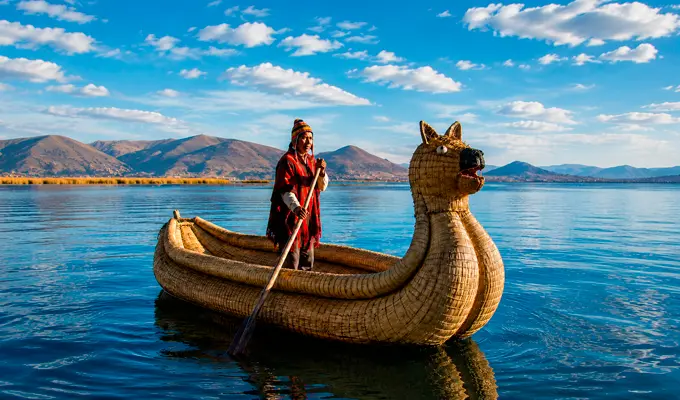
The history of these watercraft dates back to the pre-Inca civilizations that inhabited the region thousands of years ago. These ancient peoples carefully observed the reeds growing along the shores of the lake and discovered their unique qualities: exceptional natural buoyancy, remarkable water resistance, ideal flexibility for weaving, and ease of harvesting and drying. Using these characteristics, they developed construction techniques so ingenious that they have been proudly passed down from generation to generation and continue to be practiced today.
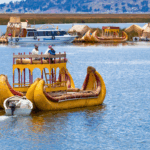
One of the most remarkable examples of this ancestral heritage is the existence of the Uros Floating Islands. These extraordinary islands are built entirely from totora reeds, forming stable artificial platforms where families live, work, and preserve their traditions. What makes this ecosystem truly fascinating is that the same material serves countless purposes: it is used to build traditional homes, create beautiful handicrafts, construct boats, and even form the floating surfaces on which people live. In this unique environment, the Caballitos de Totora become the essential means of transportation and fishing, allowing residents to navigate the lake with ease.
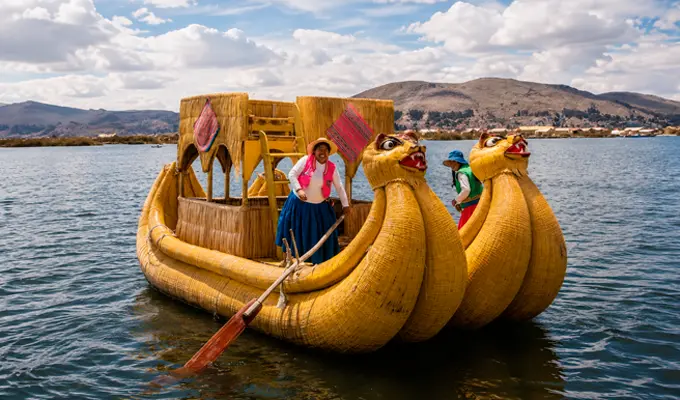
Building these traditional watercraft is a highly specialized artisanal process. It begins with harvesting totora reeds from the wettest areas of Lake Titicaca, followed by a natural drying process that reduces their internal moisture. Once ready, the reeds are bundled into compact sections, carefully tied together, and shaped by hand into their distinctive elongated form. Finally, the structure is progressively reinforced with additional layers of reeds, resulting in not only a practical vessel but also a true masterpiece of ancestral craftsmanship.
These traditional highland boats can reach several meters in length and are carefully designed to safely support the weight of a fisherman along with all of their equipment. Although they are remarkably lightweight, they also reflect the challenges of working with natural materials. Since totora is organic, it gradually deteriorates when exposed to water, requiring continuous maintenance through the periodic replacement of its outer layers.
Among their most outstanding qualities is the fact that they are completely eco-friendly and biodegradable vessels, built entirely through traditional craftsmanship without machinery. They are perfectly suited for artisanal fishing and represent an enduring cycle of care, renewal, and harmony with nature.
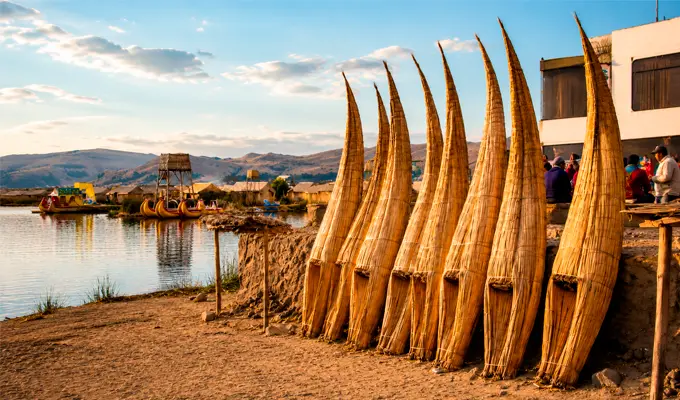
Today, Lake Titicaca is not only home to an extraordinary traditional way of life but also one of Peru’s leading cultural tourism destinations. Travelers from around the world are drawn by the opportunity to sail aboard these traditional reed boats, visit the famous floating islands, learn directly from the ancient Uros culture, and take part in authentic cultural experiences that leave lasting memories. It is living proof that when a tradition is preserved with dedication and pride, it becomes a bridge connecting the past with the entire world.
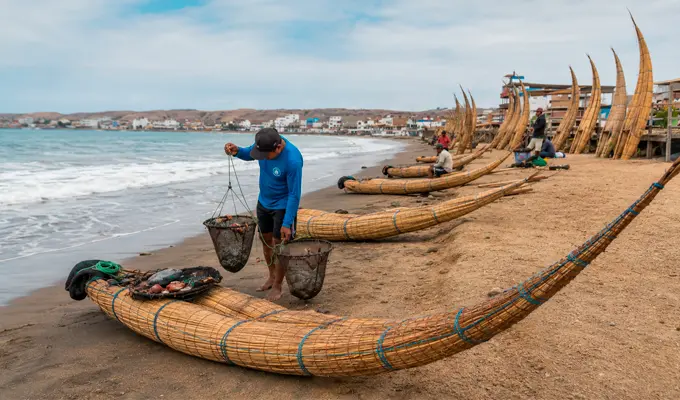
Although many people primarily associate these traditional reed boats with the landscapes of the Puno Altiplano, the truth is that their most iconic, vibrant, and enduring use can be found along Peru’s northern coast, especially throughout the shoreline of the La Libertad region. Near the city of Trujillo, and most notably in the seaside town of Huanchaco, the Caballitos de Totora continue to play an essential role in artisanal fishing to this day. They represent a living cultural tradition that has survived uninterrupted for more than two thousand years.
On the beaches of Huanchaco, these traditional watercraft are not static museum exhibits or relics of the past—they remain an essential part of everyday life. Local fishermen, respectfully known as the “men of the caballito”, continue to venture into the Pacific Ocean aboard these handcrafted reed vessels. Every journey demonstrates remarkable skill and courage, inherited directly from the ancient Moche and Chimú civilizations.
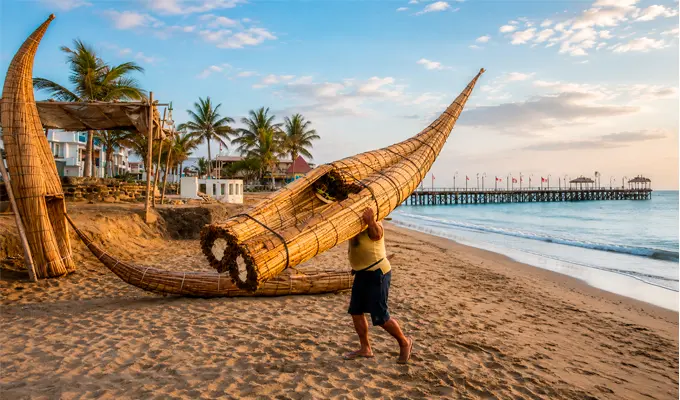
This fascinating tradition traces its origins back to the ancient societies that once flourished along Peru’s northern coast. The Moche civilization, in particular, carefully depicted similar reed boats in their ceramics and clay reliefs, illustrating their use for both daily fishing and maritime trade. Despite centuries of historical change, this custom never disappeared. Instead, it has endured because its techniques and knowledge have been proudly passed down from generation to generation.
Unlike the calm waters of the Andean highlands, the reed boats used along Peru’s northern coast are specifically designed to withstand the powerful waves of the Pacific Ocean. Their daily use includes essential activities such as artisanal fishing, skillfully navigating through breaking waves, transporting fishing nets and equipment, and returning swiftly to shore once the day's work is complete. Fishermen launch directly from the beach, riding through the surf with remarkable expertise, demonstrating an extraordinary mastery of and respect for the sea.
The immense historical, social, and cultural significance of the Caballito de Totora in Huanchaco has earned it official recognition as part of Peru’s National Cultural Heritage. Beyond this distinction, Huanchaco has established itself as one of the most important destinations along Peru’s northern tourist routes. Every year, visitors from around the world come to witness this ancient tradition in action, a living testament to the enduring identity of Peru’s northern coast, still written upon the waves.