The Gate of the Sun at Tiwanaku is, without a doubt, one of the most extraordinary monuments in all of South America. Standing proudly on the Bolivian Altiplano, near the legendary Lake Titicaca, this remarkable structure rises at the heart of the ancient ceremonial center of Tiwanaku, where it has captivated scientists, historians, and travelers from around the world for centuries.
What makes the Gate of the Sun truly exceptional is not only its imposing appearance but also the extraordinary craftsmanship behind its construction. It was carved from a single massive block of andesite stone. Its surface is adorned with intricate carvings that appear to preserve a sacred language, making it the ultimate testament to the remarkable architectural, technological, and spiritual achievements of the Tiwanaku civilization. Flourishing long before the rise of the Inca Empire, this ancient culture engraved its wisdom into stone, leaving behind a legacy that continues to invite us to unravel the mysteries of the Andean world.
The Gate of the Sun is a monumental monolithic gateway built by the Tiwanaku civilization between the 6th and 10th centuries AD. It stands within the archaeological complex of Tiwanaku, a UNESCO World Heritage Site and one of Bolivia's most important archaeological landmarks.
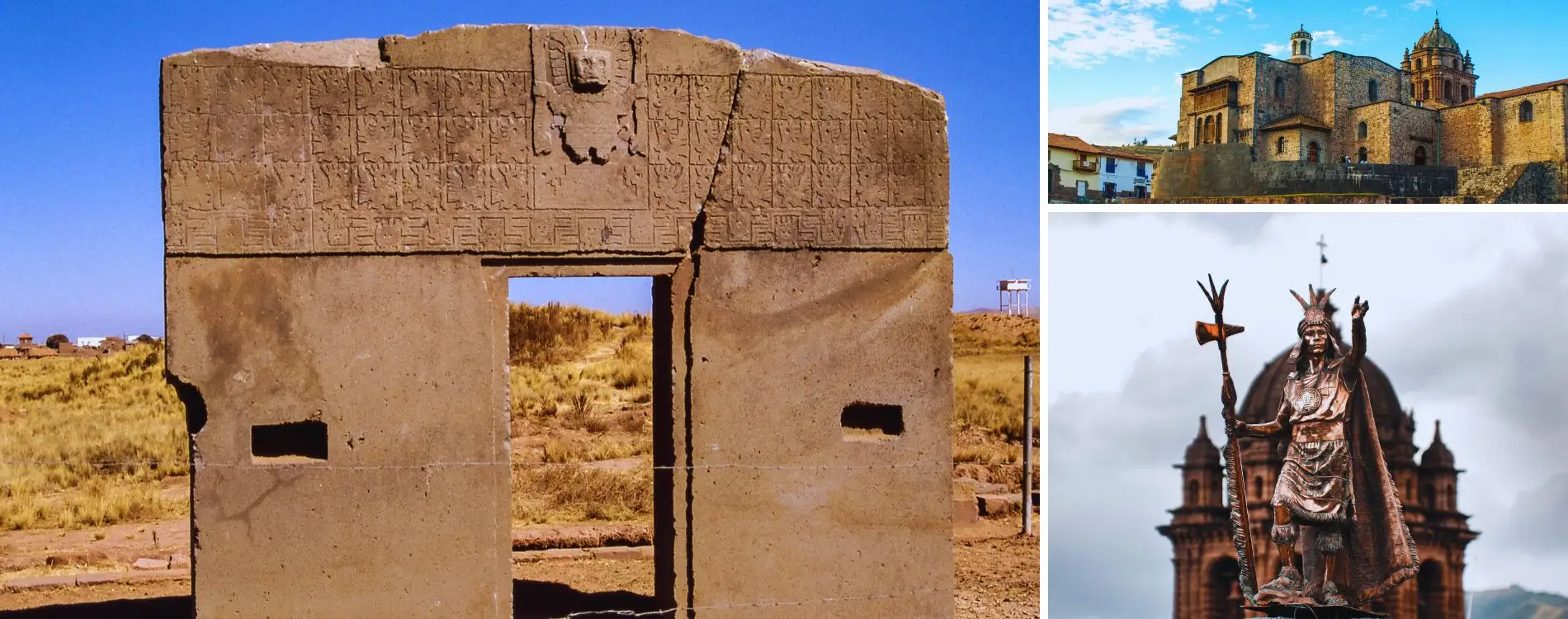
The monument measures approximately 3 meters (10 feet) high and 4 meters (13 feet) wide. It was carved from a single block of andesite weighing nearly 10 tons. Despite the passage of centuries, it remains one of the greatest masterpieces of pre-Hispanic engineering.
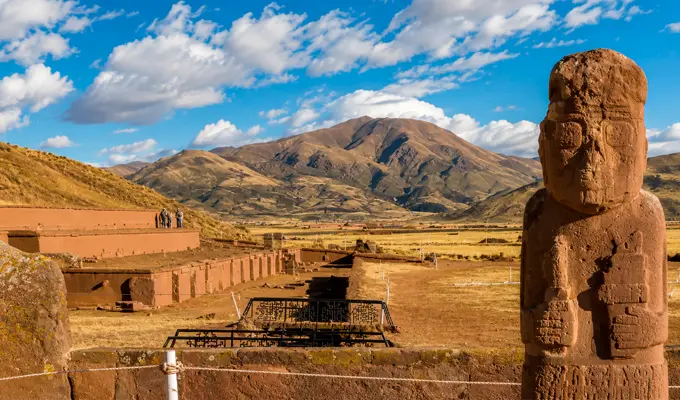
The Gate of the Sun was a key element of the magnificent ceremonial center of Tiwanaku, a civilization that emerged near the shores of Lake Titicaca and extended its cultural and ideological influence across territories that today belong to Bolivia, Peru, Chile, and Argentina. Its impact was so profound that it fundamentally reshaped the cultural landscape of the ancient Andes.
However, time and the passing of civilizations did not spare the monument. When Spanish explorers arrived in the region during the 16th century, they encountered a desolate scene: the great gateway lay on the ground, toppled over and partially fractured. Evidence suggests that it was not originally a standalone monument but rather part of a much larger temple or ceremonial complex. One of the greatest mysteries facing modern archaeologists is that, to this day, no one has been able to determine its exact original location within the archaeological site.
Despite the damage carved into the stone, its rediscovery sparked a fascination that has never faded. Since then, generations of scholars have devoted themselves to studying the monument, striving to decipher the hidden meaning behind its intricate carvings and uncover the sacred or astronomical role this extraordinary structure played at the heart of Tiwanaku society.
| Aspect | Key Information |
| Origin and Characteristics | The Gate of the Sun was built by the Tiwanaku civilization between the 6th and 10th centuries AD. It was carved from a single block of andesite weighing approximately 10 tons and measures about 3 meters (10 ft) high and 4 meters (13 ft) wide. |
| Historical Importance | It formed part of the ancient ceremonial center of Tiwanaku, one of South America's most significant archaeological sites and a UNESCO World Heritage Site. |
| The Staff God | Its upper section features the iconic figure known as the Staff God, one of the principal Andean deities, whom many researchers associate with Viracocha, the creator god. |
| Astronomical Enigma | Its carvings may represent a solar calendar, used to track agricultural cycles, solstices, equinoxes, and religious ceremonies of the Tiwanaku civilization. |
| Cultural and Tourist Value | Located 70 km (43 miles) from La Paz, Bolivia, near Lake Titicaca, it is the most iconic symbol of the Tiwanaku civilization and one of the most visited and extensively studied archaeological monuments in the Andes. |
Among all the remarkable details of the Gate of the Sun, the feature that immediately captures every visitor's attention is the imposing central figure carved into its upper section. In archaeology, this deity is known as the "Staff God" or "Lord of the Staffs", and is regarded as one of the most powerful and widespread divine figures in all Andean iconography. Many researchers firmly associate this image with Viracocha, the creator deity who centuries later became the supreme god of the Inca worldview.
The Gateway of the Sun of Tiwanaku is, without a doubt, one of the most extraordinary monuments in all of South America. Guarded by the heights of the Bolivian Altiplano, near the legendary Lake Titicaca, this remarkable structure stands at the heart of the ancient ceremonial center of Tiwanaku, where it has inspired awe and curiosity among scientists, historians, and travelers from around the world for centuries.
What makes the Gateway of the Sun truly exceptional is not only its imposing presence, but also the extraordinary craftsmanship behind its creation: it was carved from a single massive block of andesite stone. Its surface is covered with intricate reliefs that appear to conceal a sacred language, making it the ultimate testament to the remarkable architectural, technical, and spiritual achievements of the Tiwanaku civilization. Flourishing long before the rise of the Inca Empire, this ancient culture engraved a legacy of wisdom into stone that continues to invite us to unravel the mysteries of the Andean world.
The Gateway of the Sun is a monumental monolithic portal built by the Tiwanaku civilization between the 6th and 10th centuries AD. It is located within the Tiwanaku Archaeological Site, recognized as a UNESCO World Heritage Site and one of the most significant archaeological landmarks in Bolivia.
The monument stands approximately 3 meters (10 feet) high and 4 meters (13 feet) wide, carved from a single block of andesite weighing nearly 10 tons. Despite the passage of centuries, it remains one of the finest masterpieces of pre-Hispanic engineering.
The Gateway of the Sun was a key element within the magnificent ceremonial center of Tiwanaku, a civilization that flourished under the influence of Lake Titicaca and extended its cultural and ideological reach across territories that today belong to Bolivia, Peru, Chile, and Argentina. Its influence was so profound that it reshaped the political and cultural landscape of the ancient Andes.
However, time and the passing of civilizations did not spare the monument. When Spanish explorers arrived in the region during the 16th century, they found the great gateway lying on the ground, toppled and partially fractured. Archaeologists believe it was originally part of a much larger temple or ceremonial complex rather than standing alone. One of the greatest mysteries that continues to puzzle researchers is that no one has yet determined its exact original location within the archaeological site.
Despite the damage carved into its stone, the rediscovery of the monument sparked a fascination that has never faded. Since then, generations of scholars have devoted themselves to studying its carvings, seeking to decipher the hidden messages engraved on its surface and understand the sacred or astronomical role this remarkable structure played at the heart of Tiwanaku society.
| Aspect | Key Information |
| Origin and Characteristics | The Gateway of the Sun was built by the Tiwanaku civilization between the 6th and 10th centuries AD. It was carved from a single block of andesite weighing approximately 10 tons and measures about 3 meters high by 4 meters wide. |
| Historical Importance | It formed part of the ancient ceremonial center of Tiwanaku, one of South America's most important archaeological sites and a UNESCO World Heritage Site. |
| The Staff God | The upper section features the iconic image of the Staff God, one of the principal deities of the Andes, identified by many researchers with Viracocha, the creator god. |
| Astronomical Enigma | Its reliefs may represent a sophisticated solar calendar, used to track agricultural cycles, solstices, equinoxes, and religious ceremonies of the Tiwanaku civilization. |
| Cultural and Tourist Value | Located approximately 70 km from La Paz, Bolivia, near Lake Titicaca, it is the most recognizable symbol of Tiwanaku culture and one of the most visited and studied archaeological monuments in the Andes. |
Among all the remarkable details of the Gateway of the Sun, the feature that immediately captures attention is the imposing figure carved at the top center of the monument. Archaeologists know this deity as the "Staff God" or "Lord of the Staffs", one of the most powerful and widespread divine figures in Andean iconography. Many researchers believe it represents Viracocha, the creator god who centuries later occupied the highest place in the Inca worldview.
In the relief, the deity stands in a commanding posture, firmly holding two ceremonial staffs. Surrounding the central figure is a procession of mysterious winged beings that appear to march toward the deity in reverence. For many scholars, this extraordinary composition is far more than decorative art—it is a spiritual map symbolizing the order of the cosmos, the manifestation of divine power, and the profound connection that the ancient peoples of the Altiplano perceived between humanity and the universe.
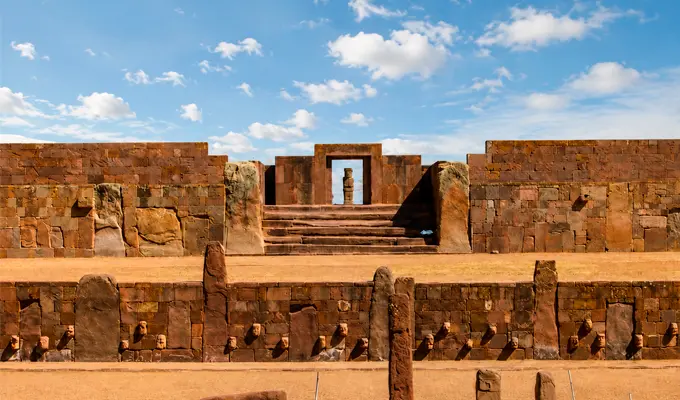
Beyond its undeniable spiritual significance, many researchers view the Gateway of the Sun as an enormous book of ancient scientific knowledge. For decades, archaeologists and astronomers have proposed fascinating theories suggesting that the monument's intricate carvings conceal an advanced astronomical function.
Surrounding the imposing central deity are dozens of meticulously arranged reliefs organized in precise rows. Several researchers argue that these symbols are not random decorations but instead represent a sophisticated solar calendar. According to this interpretation, it served as an essential tool used by Tiwanaku priests and scholars to accurately track agricultural cycles, predict solstices and equinoxes, and schedule the religious ceremonies that governed life across the Altiplano.
Although scholars have yet to reach a definitive consensus regarding the meaning of every symbol, most specialists agree that the Gateway of the Sun functioned as a symbolic bridge between Earth and the heavens. It was a monument deeply connected to astronomical observation, designed to express in living stone the sophisticated worldview of the ancient Andean civilizations.
To fully understand the significance of the Gateway of the Sun, it is essential to journey back to the heart of the Tiwanaku civilization. This extraordinary culture flourished on the Andean Altiplano under the influence of Lake Titicaca and reached its golden age between AD 500 and 1000. During these five centuries of prosperity, Tiwanaku emerged as one of the most powerful political, religious, and cultural centers in all of South America.
Despite the harsh environmental conditions imposed by the high Andes, the people of Tiwanaku displayed extraordinary ingenuity. They not only constructed monumental temples and ceremonial complexes that continue to inspire admiration today, but also developed advanced agricultural systems capable of thriving in the challenging Altiplano climate. Their influence spread across vast regions of the Andes, leaving such a profound architectural and cultural legacy that centuries later the Incas themselves drew inspiration from their achievements.
```htmlFor all these reasons, when we stand before the Gateway of the Sun, we are not merely looking at a masterpiece of art or an extraordinary feat of ancient architecture; we are witnessing the living testimony and enduring legacy of one of the most influential and remarkable civilizations in Andean history.
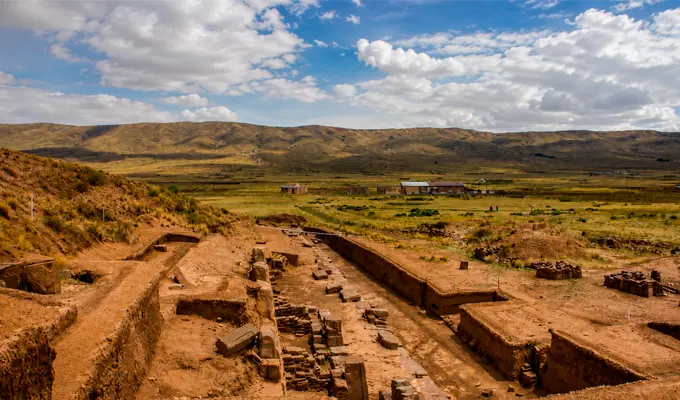
To experience this extraordinary landmark of the Altiplano firsthand, you must travel to the department of La Paz in Bolivia. The mystical gateway stands within the Tiwanaku Archaeological Site, strategically located just 70 kilometers (43 miles) from the city of La Paz and only a short distance from the sacred waters of Lake Titicaca.
Today, this remarkable destination has become a cultural pilgrimage site that welcomes thousands of visitors and history enthusiasts each year. Travelers arrive from every corner of the globe with the same purpose: to admire the grandeur of its monumental stone structures, uncover the story of the Tiwanaku civilization, and explore firsthand one of the most sacred and significant treasures of South America's archaeological heritage.
When we examine the physical dimensions and remarkable details of the Gateway of the Sun, admiration quickly turns into amazement. This timeless monument is more than 1,500 years old and, defying the engineering limitations of its era, was meticulously carved from a single block of andesite stone. Transporting and sculpting this colossal monument, weighing approximately 10 tons, across the vast Altiplano remains one of the greatest achievements of ancient engineering.
The passage of time and the course of history have left visible scars on the monument, the most famous being a large crack that has remained visible for centuries. Even so, the Gateway has preserved its majesty, continuing to safeguard the mysterious carvings that many experts interpret as an advanced astronomical calendar.
Thanks to both its monumental beauty and the profound knowledge it embodies, the Gateway of the Sun has become the most iconic symbol of the Tiwanaku civilization. Far from being a static relic displayed in an open-air museum, this stone portal remains a living monument that continues to inspire archaeological research and fascinating studies into the astronomical knowledge of the ancient Andean world.