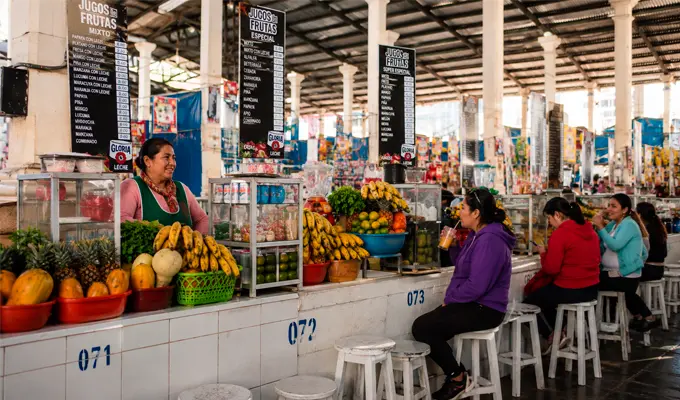
The San Pedro Central Market is much more than a place to shop; it is the vibrant, everyday heartbeat of Cusco. Stepping inside means immersing yourself in an explosion of aromas, colors, and flavors where Andean tradition can be felt in every corner. Walking through its aisles is the most authentic way to experience the daily life of the people of Cusco, surrounded by conversations in Quechua and stalls overflowing with local products.
Located just a few steps from the Plaza de Armas and directly across from the historic train station, the market is a fascinating meeting point. Here, locals shopping for their daily essentials mingle with travelers from around the world looking to sample traditional cuisine, purchase unique handicrafts, or simply experience the authentic spirit of the ancient Inca capital.
| Information | Details |
| Location | Historic Center of Cusco |
| Opened | 1925 |
| Architect | Gustave Eiffel (metal structure) |
| Market Stalls | Approximately 1,180 |
| Main Attraction | Andean cuisine and local products |
| Opening Hours | 6:30 a.m. – 5:00 p.m. |
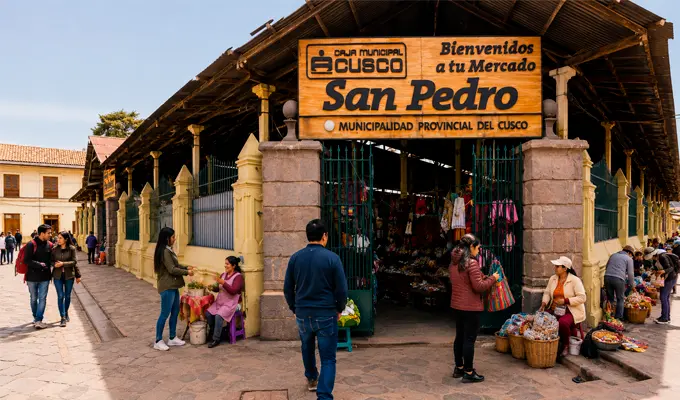
With more than a century of history, the San Pedro Central Market is the oldest, largest, and most iconic market in Cusco. Every day, this bustling marketplace feeds the heart of the city, offering everything from fresh meat and vegetables to medicinal herbs, textiles, and agricultural products brought directly from the Sacred Valley and the Andean highlands.
With nearly 1,180 market stalls, San Pedro is not only an essential economic hub for hundreds of local families but also a vibrant cultural space where ancestral knowledge, living traditions, and the dynamic daily life of Cusco come together.
The history of San Pedro Market is closely linked to the growth and modernization of Cusco in the early 20th century. At that time, the city's daily commerce had no permanent location and took place outdoors in the Plaza de Armas, where farmers and vendors displayed their produce directly on the ground. To organize the city and provide merchants with a permanent marketplace, plans were made to build a large central market.
In 1910, during the administration of Mayor Manuel Silvestre Frisancho, the ambitious project began. The impressive metal framework supporting the building was commissioned from the renowned French engineer Gustave Eiffel, the creator of the Eiffel Tower in Paris, giving the market a remarkable industrial architectural style that was ahead of its time.
The market officially opened its doors in 1925 under the name Frisancho Market. However, the people of Cusco naturally came to call it San Pedro Market because of its proximity to the historic colonial church of the same name. Over the years, the market expanded and evolved, yet its original iron structure remains intact, making it one of the most significant historical and cultural landmarks in Cusco.
The market is located in San Pedro Square, directly across from the historic church of the same name and just a 10-minute walk from Cusco's Plaza de Armas.
Its prime location makes it an easy stop on any walking tour through the Historic Center. It is the perfect place to take a break, enjoy local food, or capture memorable photos before or after visiting the city's most iconic attractions.
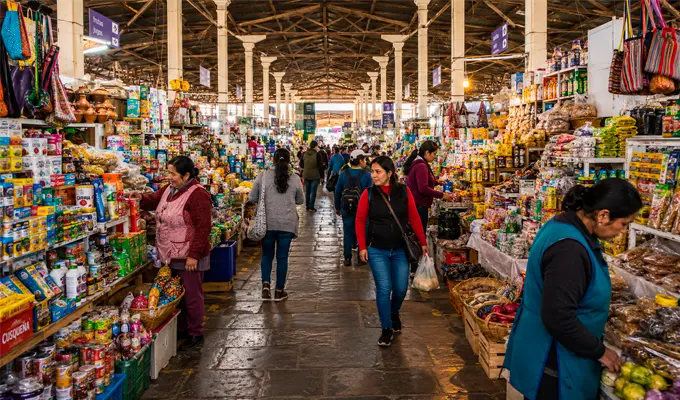
San Pedro Market is organized into clearly defined sections, making it easy to explore and discover the incredible richness of the region in every aisle:
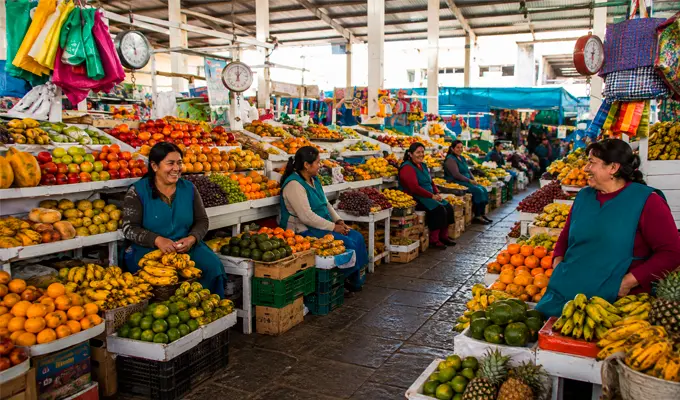
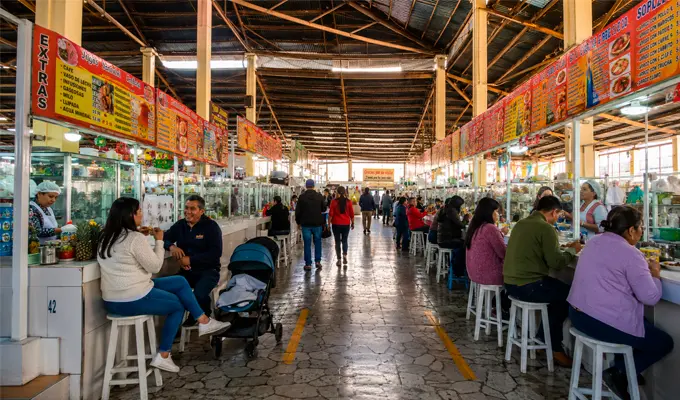
More than just a traditional marketplace, San Pedro Market is the true social heart of Cusco a genuine gathering place where the city's daily life unfolds without filters or pretension. It is one of the few places where barriers disappear, as travelers from around the world and local families naturally share tables, walk the same aisles, and exchange conversations.
Exploring its lively corridors is a complete sensory experience and an unforgettable opportunity to immerse yourself in living Andean culture. It is the perfect place to enjoy freshly prepared traditional dishes, exchange smiles with the friendly local vendors known as "caseras", and experience firsthand the warmth, ancestral knowledge, and customs that define the authentic identity of Cusco.
Tip: The early morning is the best time to visit the market. You'll find freshly prepared breakfasts and witness the authentic rhythm of the city as it comes to life.
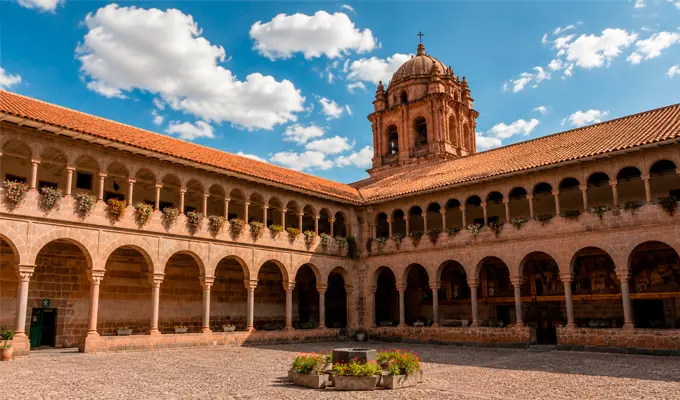
In the heart of Cusco stands one of the most impressive and fascinating monuments of the Inca civilization: Qoricancha, historically known as the Temple of the Sun. During the time of the Tawantinsuyu, this sacred complex was far more than just another temple—it was the spiritual, political, and astronomical center of the entire empire. It was conceived as the point from which the roads and ceques (sacred lines) extended toward the four regions of the Inca realm.
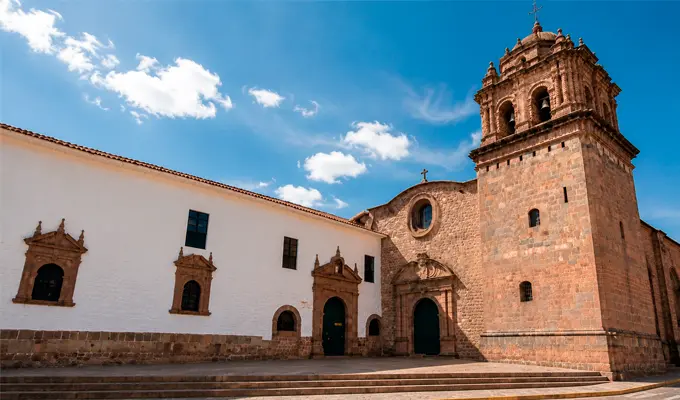
Dedicated primarily to the god Inti (the Sun), its walls were originally covered with dazzling sheets of pure gold that reflected the brilliant Andean sunlight. After the arrival of the Spanish, the Convent of Santo Domingo was built directly on top of its Inca stone foundations, creating a remarkable architectural contrast where Inca engineering has demonstrated extraordinary resistance to the earthquakes that have shaken Cusco throughout the centuries.
Today, Qoricancha is an essential stop for anyone exploring Cusco's historic center. Walking through its interior chambers allows visitors to admire the flawless craftsmanship of its black granite blocks and gain a deeper understanding of the profound cosmic and spiritual worldview that shaped the Andean civilization.
| Fact | Information |
| Location | Cusco, Peru |
| Meaning | Golden Enclosure |
| Construction | 13th century |
| Main Deity | Inti (Sun God) |
| Architecture | Inca and Colonial |
| Main Attraction | Temple of the Sun |
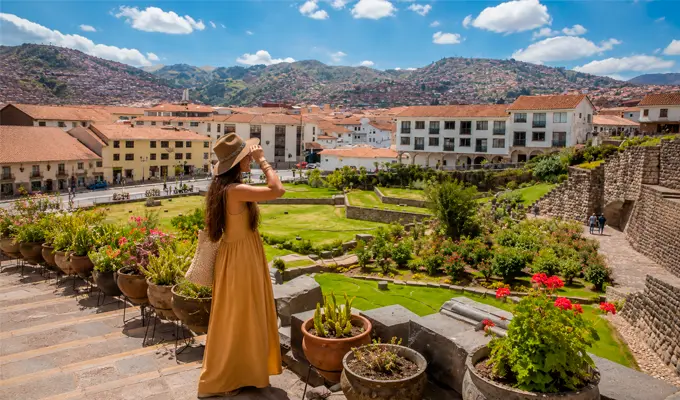
The name Qoricancha (also spelled Coricancha or Koricancha) perfectly captures the splendor of its golden age. It comes from two essential Quechua words:
Literally translated as the "Golden Enclosure" or "Temple of Gold," the name was no mere metaphor. At the height of the Inca Empire, both the interior and exterior walls of the complex were adorned with wide sheets of pure gold that gleamed under the sunlight. Its inner gardens also featured life-sized sculptures of corn plants, llamas, and shepherds crafted entirely from gold and silver, transforming the sanctuary into an earthly representation of divine abundance.
Before becoming the empire's great ceremonial center, this site was known as Inticancha or Intiwasi ("House of the Sun"), and its earliest structures date back to around 1200 AD.
The temple underwent its greatest transformation during the 15th century under the rule of the Inca Pachacútec, who ordered it to be expanded, covered its walls with sheets of gold and silver, and filled it with sacred statues. Qoricancha then became the political, religious, and astronomical heart of the Tawantinsuyu, serving as the origin of the ceques, the sacred lines that connected the entire empire.
In the 16th century, following the Spanish conquest, the temple was stripped of its treasures. The Church and Convent of Santo Domingo were built upon its remarkably solid Inca foundations. Today, this architectural fusion stands as a testament to Inca engineering: while the colonial structure suffered severe damage during the earthquakes of 1650 and 1950, the original Inca stone walls remained standing.
Qoricancha was much more than a place of worship—it was the beating heart of the Inca world. Within its sacred walls, the Incas honored Inti, the Sun God, whom they believed to be the divine protector of their people and the ancestor of the Inca rulers.
Its significance extended far beyond religion. From this very point began the ceque system, an invisible network of sacred lines and ceremonial routes linking the center of Cusco to hundreds of shrines scattered throughout the empire. In the Inca worldview, Qoricancha represented the origin of everything the geographic center, the spiritual heart, and the force that united the entire Tawantinsuyu.
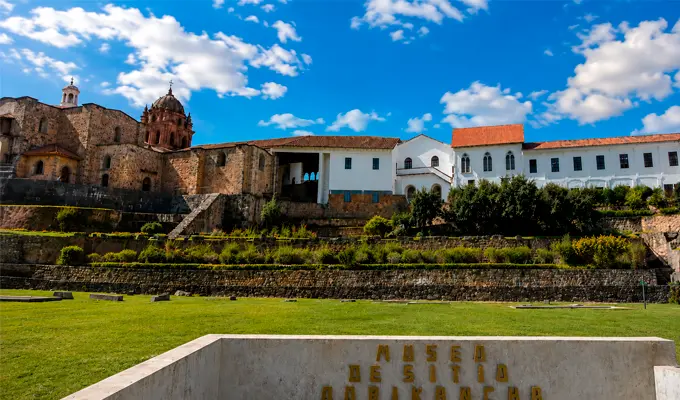
Beyond its sacred significance, Qoricancha is a true masterpiece of Andean engineering. The way its builders mastered stone construction continues to amaze architects and engineers from around the world.
Each block of basalt and andesite was carved, polished, and fitted together with such extraordinary precision that it is impossible to slide even a sheet of paper between them. Even more remarkable is the fact that no mortar or binding material was used. Instead, the stones were joined through an ingenious system of interlocking cuts and inward-leaning walls, allowing the structure to respond flexibly to earthquakes. When the ground shakes, the stones move slightly, settle back into place, and maintain the stability of the building. This is why, while powerful earthquakes damaged much of the colonial structure, the original Inca foundations remained standing.
What makes its architecture unique:
Qoricancha housed several sanctuaries dedicated to the principal deities of the Andean cosmos:
The gardens of Qoricancha were far more than decorative spaces they were a breathtaking sacred offering crafted from precious metals.
According to colonial chronicles, the gardens featured a life-sized artificial field filled with golden corn stalks adorned with silver leaves, alongside life-sized figures of llamas, their offspring, and shepherds, all fashioned entirely from gold and silver. Rather than displaying wealth alone, this extraordinary garden symbolized humanity's harmony with nature, the fertility of the land, and the abundance of the Tawantinsuyu.
Sadly, after the arrival of the Spanish conquistadors in the 16th century, these magnificent sculptures were dismantled, melted into bullion, and shipped to Europe, leaving behind only the memory of one of the most extraordinary gardens of the ancient Andean world.
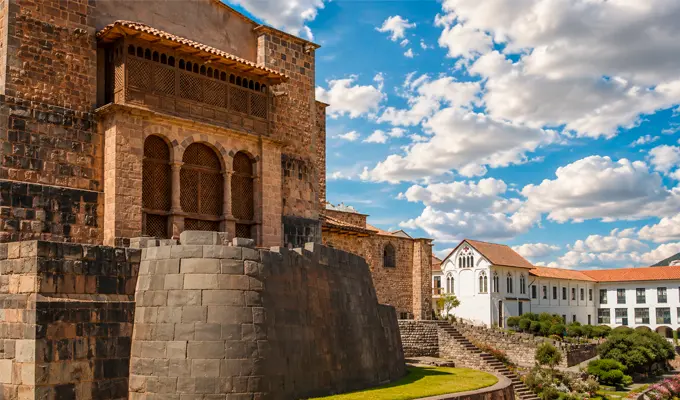
Following the Spanish conquest, the sacred sanctuary underwent a profound transformation. The Dominican Order built the Convent and Church of Santo Domingo directly on top of the finely crafted foundations of the Inca temple.
The most remarkable aspect of this encounter between two civilizations became evident centuries later, when nature tested both structures. While the devastating earthquakes of 1650, 1749, and 1950 severely damaged the colonial arches, vaults, and bell towers, the Inca stone walls remained virtually untouched, thanks to their sophisticated earthquake-resistant engineering.
Today, walking through Qoricancha offers visitors a unique historical experience: a place where the strength, precision, and elegance of Inca stonework coexist seamlessly with the artistic beauty of Colonial Baroque architecture.
Pachamama, or Mother Earth, is at the very heart of the Andean worldview. Long before the rise of the Inca Empire, she was revered as the sacred source of life, fertility, and the essential balance between humanity and nature. Although her main celebration takes place every August 1, her presence remains deeply rooted throughout the year in communities across Peru, Bolivia, Ecuador, Argentina, Chile, and the entire Andean region.
In this article, you'll discover who Pachamama truly is, what she represents in everyday life, why August 1 is her most important celebration, and how these ancient traditions continue to play a vital role in preserving Andean cultural identity today.
Pachamama is known as Mother Earth in the Andean tradition, but her meaning extends far beyond the ground beneath our feet. For Indigenous Andean peoples, she embodies the universe, nature, time, and the very space where all forms of life exist and flourish.
Within the Andean worldview, nature is not seen as a resource to be exploited, but as a living being that nourishes, protects, and sustains humanity. This is why the relationship with Pachamama is based on one essential principle: reciprocity. Receiving the Earth's gifts also means expressing gratitude and giving something back through sacred ceremonies and offerings.
| Fact | Information |
| Meaning | Mother Earth and the source of life. |
| Celebration | August 1 |
| Main Ritual | Offering to Mother Earth (Pago a la Tierra) |
| Origin | Pre-Inca Andean cultures. |
| Core Values | Gratitude and reciprocity. |
| Presence | Peru and other Andean countries. |
The word comes directly from the Quechua language:
Although it is commonly translated as "Mother Earth," its meaning goes much deeper for the Andean peoples. Pachamama represents the entirety of the natural world the origin of life and the perfect balance that unites humans, animals, mountains, water, and the cosmos.
Long before the Inca Empire existed, various Andean civilizations already honored the Earth as the ultimate source of life. Over time, the Incas strengthened this belief, making Pachamama a central pillar of their social, agricultural, and spiritual organization.
For the Incas, the Earth was sacred because it provided food, water, and everything necessary for survival. Just as they revered Inti, the Sun God, and the Apus, the sacred mountain spirits, they also honored Pachamama to maintain harmony between humanity and nature.
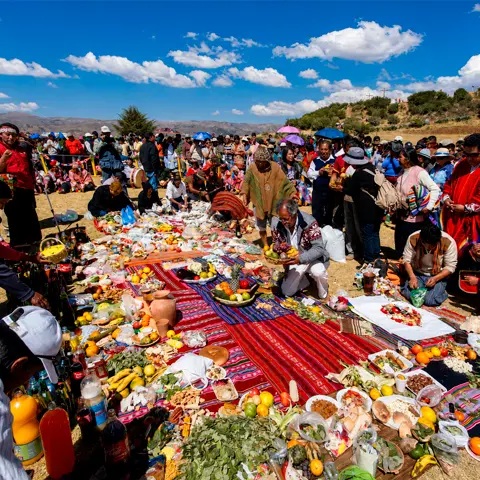
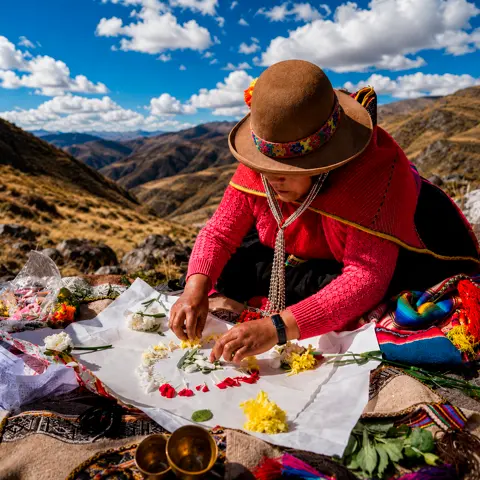
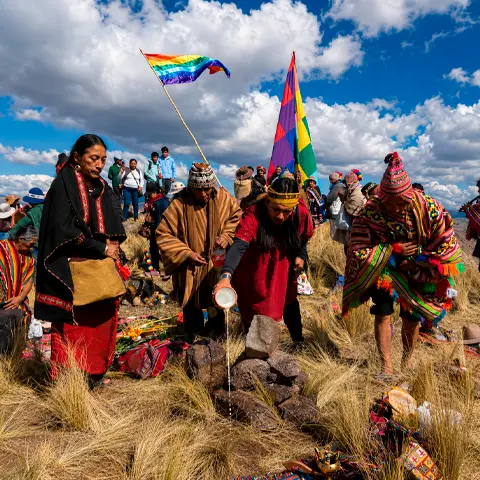
Every August 1, Andean communities celebrate Pachamama Day, a date deeply rooted in the traditional agricultural calendar of the Andes.
According to ancient tradition, this is the month when Mother Earth "awakens" after the cold winter and begins a new agricultural cycle. It is therefore the perfect time to express gratitude for past harvests and ask for prosperity, health, abundance, and favorable rains for the coming season.
Although August 1 is the main celebration, the festivities continue throughout the month in many Andean communities, making August widely recognized as the Month of Pachamama.
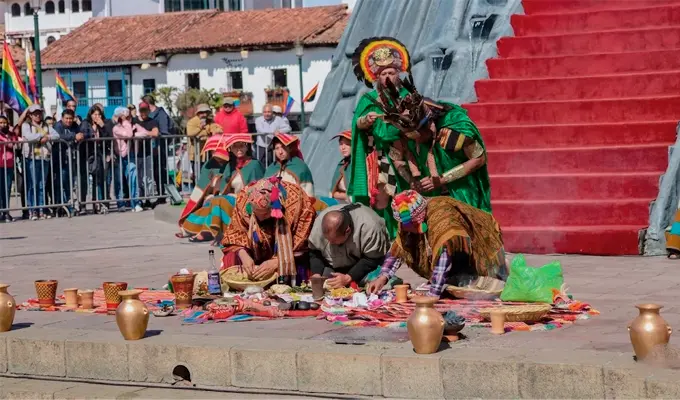
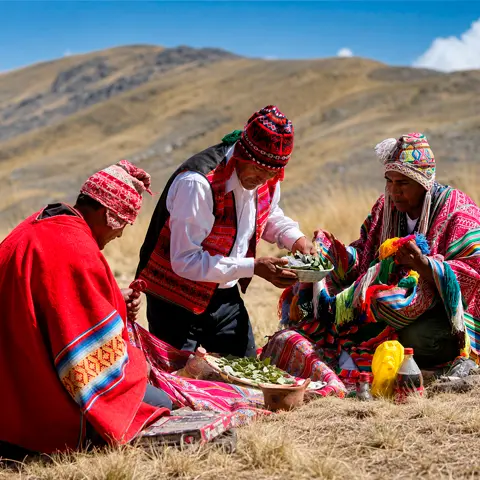
One of the most meaningful Andean rituals is the Offering to Mother Earth, also known as Haywarikuy or the Despacho to Pachamama.
This sacred ceremony is led by an Andean spiritual guide, or paqo, who carefully prepares a ceremonial offering filled with symbolic items representing gratitude, abundance, and prosperity.
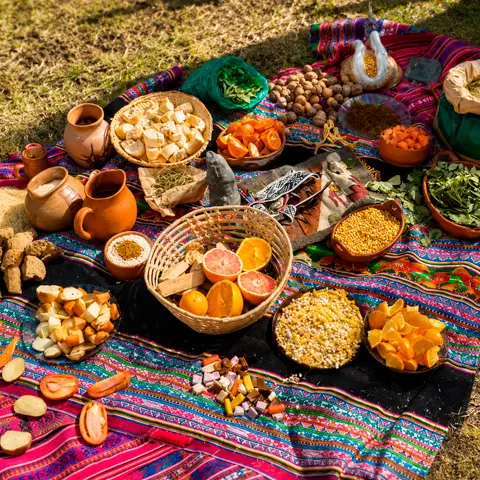
The ceremonial offering typically includes:
All of these elements are carefully arranged on a ceremonial cloth before being buried or burned, symbolizing a sacred act of gratitude and reciprocity with Mother Earth.
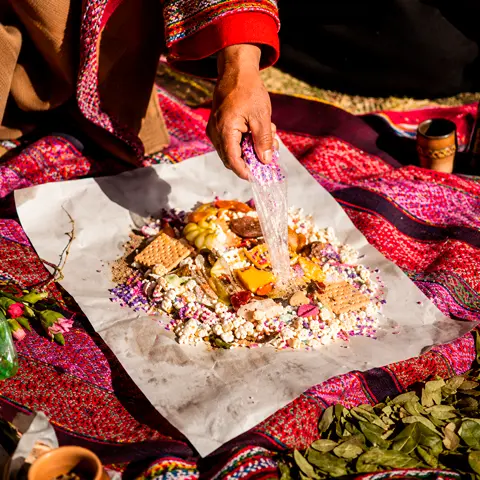
Although each Andean region has its own customs, a traditional Pachamama ceremony generally follows these steps:
More than a religious ritual, this ceremony is a profound expression of respect for nature and a powerful reminder that the cultural identity of the Andes remains alive and vibrant today.
Despite the passage of centuries, Pachamama continues to hold a central place in the lives of many Andean communities.
Today, these ceremonies bring together not only local residents but also travelers from around the world who seek to connect with Peru's most ancient traditions. At the same time, Pachamama's message of respect, gratitude, and harmony with nature has gained renewed relevance in the face of today's environmental challenges.
This ancient Andean principle of reciprocity reminds us of an essential truth: human well-being depends on protecting water, soil, mountains, and biodiversity. It is a worldview that is more meaningful and relevant today than ever before.
Although Pachamama ceremonies take place throughout Peru, some destinations preserve this tradition with exceptional authenticity. If you wish to witness or participate in one of these sacred rituals, consider visiting:
In many of these destinations—particularly throughout the month of August you can take part in authentic Pachamama ceremonies conducted with deep respect by local communities and traditional Andean spiritual leaders.
Pachamama represents Mother Earth in its fullest sense. She is the source of life, fertility, abundance, and the sacred balance that exists between nature and humanity.
August 1 marks the beginning of a new agricultural cycle in the Andes. According to tradition, this is when Mother Earth "awakens," making it the ideal time to give thanks for past blessings and ask for prosperity in the coming year.
It is an ancient Andean ceremony in which symbolic offerings such as coca leaves, seeds, sweets, and other sacred items—are presented to Pachamama as an expression of gratitude, respect, and reciprocity for the gifts and resources she provides.
Pachamama ceremonies are generally led by an Andean spiritual guide known as a paqo, who preserves and passes down the sacred knowledge and rituals from generation to generation.
Not at all. Pachamama predates the Inca Empire and was revered by numerous pre-Inca Andean civilizations. The Incas later embraced and strengthened her worship, making it a cornerstone of their culture and helping preserve these sacred traditions for future generations.
The Gate of the Sun at Tiwanaku is, without a doubt, one of the most extraordinary monuments in all of South America. Standing proudly on the Bolivian Altiplano, near the legendary Lake Titicaca, this remarkable structure rises at the heart of the ancient ceremonial center of Tiwanaku, where it has captivated scientists, historians, and travelers from around the world for centuries.
What makes the Gate of the Sun truly exceptional is not only its imposing appearance but also the extraordinary craftsmanship behind its construction. It was carved from a single massive block of andesite stone. Its surface is adorned with intricate carvings that appear to preserve a sacred language, making it the ultimate testament to the remarkable architectural, technological, and spiritual achievements of the Tiwanaku civilization. Flourishing long before the rise of the Inca Empire, this ancient culture engraved its wisdom into stone, leaving behind a legacy that continues to invite us to unravel the mysteries of the Andean world.
The Gate of the Sun is a monumental monolithic gateway built by the Tiwanaku civilization between the 6th and 10th centuries AD. It stands within the archaeological complex of Tiwanaku, a UNESCO World Heritage Site and one of Bolivia's most important archaeological landmarks.
The monument measures approximately 3 meters (10 feet) high and 4 meters (13 feet) wide. It was carved from a single block of andesite weighing nearly 10 tons. Despite the passage of centuries, it remains one of the greatest masterpieces of pre-Hispanic engineering.
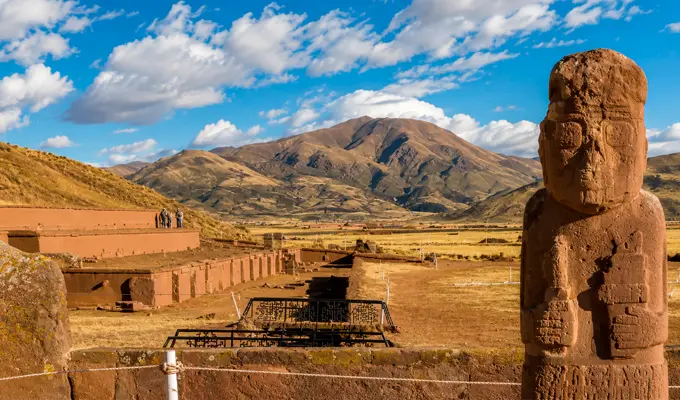
The Gate of the Sun was a key element of the magnificent ceremonial center of Tiwanaku, a civilization that emerged near the shores of Lake Titicaca and extended its cultural and ideological influence across territories that today belong to Bolivia, Peru, Chile, and Argentina. Its impact was so profound that it fundamentally reshaped the cultural landscape of the ancient Andes.
However, time and the passing of civilizations did not spare the monument. When Spanish explorers arrived in the region during the 16th century, they encountered a desolate scene: the great gateway lay on the ground, toppled over and partially fractured. Evidence suggests that it was not originally a standalone monument but rather part of a much larger temple or ceremonial complex. One of the greatest mysteries facing modern archaeologists is that, to this day, no one has been able to determine its exact original location within the archaeological site.
Despite the damage carved into the stone, its rediscovery sparked a fascination that has never faded. Since then, generations of scholars have devoted themselves to studying the monument, striving to decipher the hidden meaning behind its intricate carvings and uncover the sacred or astronomical role this extraordinary structure played at the heart of Tiwanaku society.
| Aspect | Key Information |
| Origin and Characteristics | The Gate of the Sun was built by the Tiwanaku civilization between the 6th and 10th centuries AD. It was carved from a single block of andesite weighing approximately 10 tons and measures about 3 meters (10 ft) high and 4 meters (13 ft) wide. |
| Historical Importance | It formed part of the ancient ceremonial center of Tiwanaku, one of South America's most significant archaeological sites and a UNESCO World Heritage Site. |
| The Staff God | Its upper section features the iconic figure known as the Staff God, one of the principal Andean deities, whom many researchers associate with Viracocha, the creator god. |
| Astronomical Enigma | Its carvings may represent a solar calendar, used to track agricultural cycles, solstices, equinoxes, and religious ceremonies of the Tiwanaku civilization. |
| Cultural and Tourist Value | Located 70 km (43 miles) from La Paz, Bolivia, near Lake Titicaca, it is the most iconic symbol of the Tiwanaku civilization and one of the most visited and extensively studied archaeological monuments in the Andes. |
Among all the remarkable details of the Gate of the Sun, the feature that immediately captures every visitor's attention is the imposing central figure carved into its upper section. In archaeology, this deity is known as the "Staff God" or "Lord of the Staffs", and is regarded as one of the most powerful and widespread divine figures in all Andean iconography. Many researchers firmly associate this image with Viracocha, the creator deity who centuries later became the supreme god of the Inca worldview.
The Gateway of the Sun of Tiwanaku is, without a doubt, one of the most extraordinary monuments in all of South America. Guarded by the heights of the Bolivian Altiplano, near the legendary Lake Titicaca, this remarkable structure stands at the heart of the ancient ceremonial center of Tiwanaku, where it has inspired awe and curiosity among scientists, historians, and travelers from around the world for centuries.
What makes the Gateway of the Sun truly exceptional is not only its imposing presence, but also the extraordinary craftsmanship behind its creation: it was carved from a single massive block of andesite stone. Its surface is covered with intricate reliefs that appear to conceal a sacred language, making it the ultimate testament to the remarkable architectural, technical, and spiritual achievements of the Tiwanaku civilization. Flourishing long before the rise of the Inca Empire, this ancient culture engraved a legacy of wisdom into stone that continues to invite us to unravel the mysteries of the Andean world.
The Gateway of the Sun is a monumental monolithic portal built by the Tiwanaku civilization between the 6th and 10th centuries AD. It is located within the Tiwanaku Archaeological Site, recognized as a UNESCO World Heritage Site and one of the most significant archaeological landmarks in Bolivia.
The monument stands approximately 3 meters (10 feet) high and 4 meters (13 feet) wide, carved from a single block of andesite weighing nearly 10 tons. Despite the passage of centuries, it remains one of the finest masterpieces of pre-Hispanic engineering.
The Gateway of the Sun was a key element within the magnificent ceremonial center of Tiwanaku, a civilization that flourished under the influence of Lake Titicaca and extended its cultural and ideological reach across territories that today belong to Bolivia, Peru, Chile, and Argentina. Its influence was so profound that it reshaped the political and cultural landscape of the ancient Andes.
However, time and the passing of civilizations did not spare the monument. When Spanish explorers arrived in the region during the 16th century, they found the great gateway lying on the ground, toppled and partially fractured. Archaeologists believe it was originally part of a much larger temple or ceremonial complex rather than standing alone. One of the greatest mysteries that continues to puzzle researchers is that no one has yet determined its exact original location within the archaeological site.
Despite the damage carved into its stone, the rediscovery of the monument sparked a fascination that has never faded. Since then, generations of scholars have devoted themselves to studying its carvings, seeking to decipher the hidden messages engraved on its surface and understand the sacred or astronomical role this remarkable structure played at the heart of Tiwanaku society.
| Aspect | Key Information |
| Origin and Characteristics | The Gateway of the Sun was built by the Tiwanaku civilization between the 6th and 10th centuries AD. It was carved from a single block of andesite weighing approximately 10 tons and measures about 3 meters high by 4 meters wide. |
| Historical Importance | It formed part of the ancient ceremonial center of Tiwanaku, one of South America's most important archaeological sites and a UNESCO World Heritage Site. |
| The Staff God | The upper section features the iconic image of the Staff God, one of the principal deities of the Andes, identified by many researchers with Viracocha, the creator god. |
| Astronomical Enigma | Its reliefs may represent a sophisticated solar calendar, used to track agricultural cycles, solstices, equinoxes, and religious ceremonies of the Tiwanaku civilization. |
| Cultural and Tourist Value | Located approximately 70 km from La Paz, Bolivia, near Lake Titicaca, it is the most recognizable symbol of Tiwanaku culture and one of the most visited and studied archaeological monuments in the Andes. |
Among all the remarkable details of the Gateway of the Sun, the feature that immediately captures attention is the imposing figure carved at the top center of the monument. Archaeologists know this deity as the "Staff God" or "Lord of the Staffs", one of the most powerful and widespread divine figures in Andean iconography. Many researchers believe it represents Viracocha, the creator god who centuries later occupied the highest place in the Inca worldview.
In the relief, the deity stands in a commanding posture, firmly holding two ceremonial staffs. Surrounding the central figure is a procession of mysterious winged beings that appear to march toward the deity in reverence. For many scholars, this extraordinary composition is far more than decorative art—it is a spiritual map symbolizing the order of the cosmos, the manifestation of divine power, and the profound connection that the ancient peoples of the Altiplano perceived between humanity and the universe.
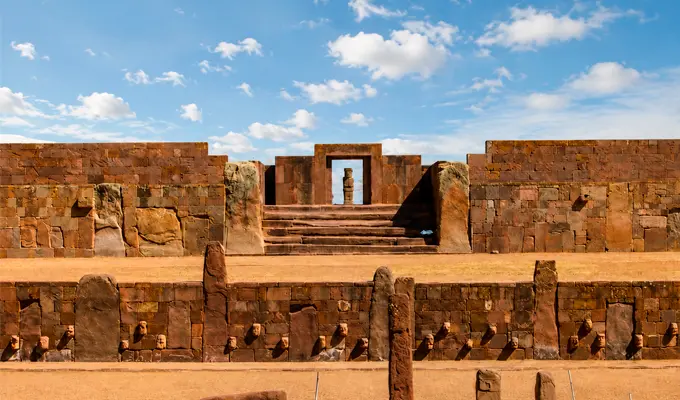
Beyond its undeniable spiritual significance, many researchers view the Gateway of the Sun as an enormous book of ancient scientific knowledge. For decades, archaeologists and astronomers have proposed fascinating theories suggesting that the monument's intricate carvings conceal an advanced astronomical function.
Surrounding the imposing central deity are dozens of meticulously arranged reliefs organized in precise rows. Several researchers argue that these symbols are not random decorations but instead represent a sophisticated solar calendar. According to this interpretation, it served as an essential tool used by Tiwanaku priests and scholars to accurately track agricultural cycles, predict solstices and equinoxes, and schedule the religious ceremonies that governed life across the Altiplano.
Although scholars have yet to reach a definitive consensus regarding the meaning of every symbol, most specialists agree that the Gateway of the Sun functioned as a symbolic bridge between Earth and the heavens. It was a monument deeply connected to astronomical observation, designed to express in living stone the sophisticated worldview of the ancient Andean civilizations.
To fully understand the significance of the Gateway of the Sun, it is essential to journey back to the heart of the Tiwanaku civilization. This extraordinary culture flourished on the Andean Altiplano under the influence of Lake Titicaca and reached its golden age between AD 500 and 1000. During these five centuries of prosperity, Tiwanaku emerged as one of the most powerful political, religious, and cultural centers in all of South America.
Despite the harsh environmental conditions imposed by the high Andes, the people of Tiwanaku displayed extraordinary ingenuity. They not only constructed monumental temples and ceremonial complexes that continue to inspire admiration today, but also developed advanced agricultural systems capable of thriving in the challenging Altiplano climate. Their influence spread across vast regions of the Andes, leaving such a profound architectural and cultural legacy that centuries later the Incas themselves drew inspiration from their achievements.
```htmlFor all these reasons, when we stand before the Gateway of the Sun, we are not merely looking at a masterpiece of art or an extraordinary feat of ancient architecture; we are witnessing the living testimony and enduring legacy of one of the most influential and remarkable civilizations in Andean history.
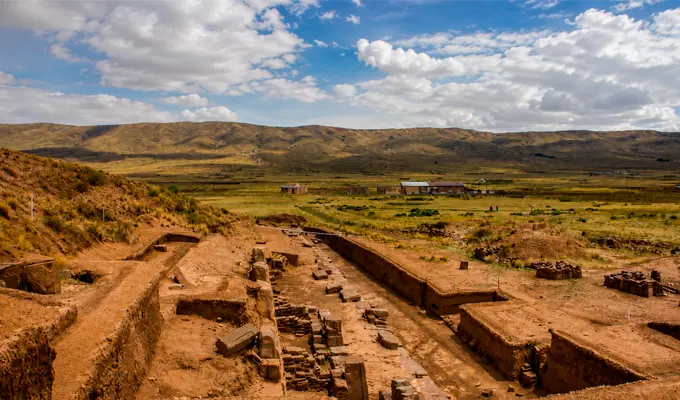
To experience this extraordinary landmark of the Altiplano firsthand, you must travel to the department of La Paz in Bolivia. The mystical gateway stands within the Tiwanaku Archaeological Site, strategically located just 70 kilometers (43 miles) from the city of La Paz and only a short distance from the sacred waters of Lake Titicaca.
Today, this remarkable destination has become a cultural pilgrimage site that welcomes thousands of visitors and history enthusiasts each year. Travelers arrive from every corner of the globe with the same purpose: to admire the grandeur of its monumental stone structures, uncover the story of the Tiwanaku civilization, and explore firsthand one of the most sacred and significant treasures of South America's archaeological heritage.
When we examine the physical dimensions and remarkable details of the Gateway of the Sun, admiration quickly turns into amazement. This timeless monument is more than 1,500 years old and, defying the engineering limitations of its era, was meticulously carved from a single block of andesite stone. Transporting and sculpting this colossal monument, weighing approximately 10 tons, across the vast Altiplano remains one of the greatest achievements of ancient engineering.
The passage of time and the course of history have left visible scars on the monument, the most famous being a large crack that has remained visible for centuries. Even so, the Gateway has preserved its majesty, continuing to safeguard the mysterious carvings that many experts interpret as an advanced astronomical calendar.
Thanks to both its monumental beauty and the profound knowledge it embodies, the Gateway of the Sun has become the most iconic symbol of the Tiwanaku civilization. Far from being a static relic displayed in an open-air museum, this stone portal remains a living monument that continues to inspire archaeological research and fascinating studies into the astronomical knowledge of the ancient Andean world.
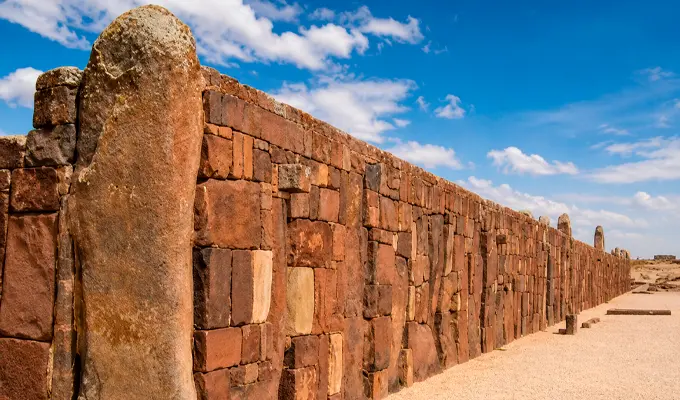
The legacy of the Incas always finds a way to amaze us once again. Far from the traditional tourist routes, in the province of Espinar, south of Cusco, rises T’aqrachullo, also known by the imposing name of María Fortaleza. This archaeological complex is one of the best-kept secrets of the Andes, a place that fascinates historians and travelers alike with its monumental architecture and its possible connection to the mythical pre-Hispanic city of Ancocagua.
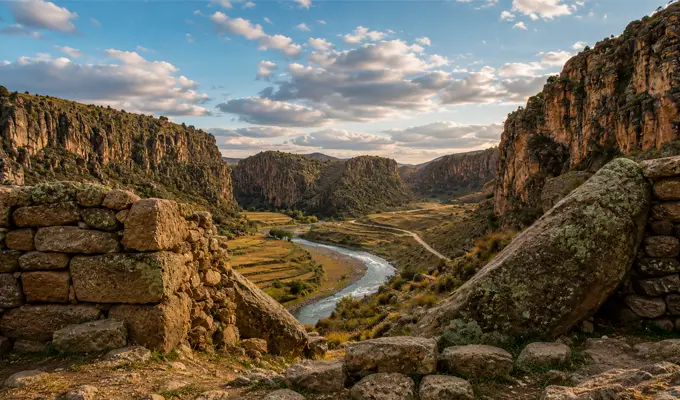
What makes T’aqrachullo truly unique is its spectacular location. Built on the edge of the majestic Three Canyons of Suykutambo, where towering volcanic rock walls overlook the landscape, this stone fortress offers a captivating blend of history, adventure, and mysticism. For those seeking to discover Peru’s purest and most hidden essence, this destination is emerging as the new cultural giant of the southern Andes a place where history is not observed in a museum but breathed in through the silence of the mountains.
For decades, T’aqrachullo remained a closely guarded secret within academic circles. However, recent research and restoration work at this Monumental Archaeological Zone, located in the province of Espinar, has revealed a complex of astonishing dimensions that is reshaping the history of Cusco.
The most fascinating aspect of Taqrachullo is that it does not belong to a single period; it is a stone book where different Andean cultures left their mark. Studies reveal that the Wari, Qolla, Cana, and Inca peoples once inhabited its streets and temples, transforming it into a powerful ceremonial, administrative, and strategic center of the southern Andes. Its mystique runs so deep that several researchers believe this imposing fortress may actually be the true Ancocagua, the legendary city and sacred sanctuary mentioned with great astonishment by the earliest colonial chroniclers in their manuscripts.
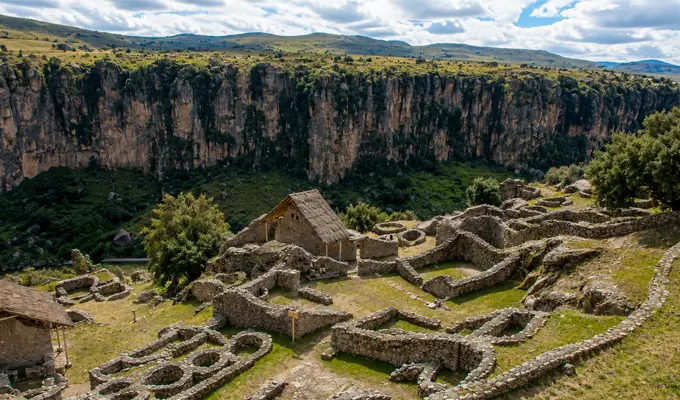
The name T’aqrachullo is a beautiful lesson in geography hidden within the Quechua language. It is commonly translated as “mother rock through which water flows”, as its ancient inhabitants did not name places at random they did so by listening to the landscape around them.
The name comes from the combination of two powerful words:
This name is, in fact, an exact reflection of the landscape you will encounter upon arrival. It speaks of an untamed territory where colossal rock outcrops and pristine water sources are not merely decorative features but the very essence of the natural environment embracing this sanctuary.
| Aspect | Key Information |
| Location | T'aqrachullo is located in the province of Espinar (Cusco), next to the impressive Three Canyons of Suykutambo, surrounded by breathtaking high-Andean landscapes. |
| Historical Significance | It is an archaeological complex occupied by the Wari, Qolla, Cana, and Inca cultures, serving as a ceremonial, administrative, and strategic center. |
| Monumental Architecture | It features nearly 600 archaeological structures spread across 17.4 hectares, including kallankas, enclosures, stairways, chullpas, and pre-Hispanic roads. |
| Archaeological Discoveries | Excavations have uncovered ceremonial gold, silver, and copper artifacts, as well as ritual structures that demonstrate its great importance within the Inca Empire. |
| The Mystery of Ancocagua | Several researchers believe that T'aqrachullo could be the legendary Inca city of Ancocagua, although this hypothesis is still under investigation. |
| Tourism Value | Thanks to ongoing restoration efforts, T'aqrachullo is emerging as one of Cusco’s most promising new archaeological destinations, ideal for travelers seeking experiences beyond the traditional tourist routes. |
The great secret of T’aqrachullo lies in how its ancient builders chose the perfect location. Perched atop an imposing Andean plateau, the complex not only served as a strategic control point but also as a privileged lookout over the breathtaking geography of Espinar.
Those who venture to this remarkable site are surrounded by a landscape of extraordinary natural beauty, where high Andean valleys give way to deep canyons and enchanting queñua forests flourish among striking rock formations. Yet the true visual climax awaits at its panoramic viewpoints, which offer direct and awe-inspiring views of the colossal Three Canyons of Suykutambo. This perfect harmony between ancient human ingenuity and untamed nature makes Taqrachullo an ideal destination for travelers seeking to escape crowded tourist circuits and connect with Peru’s most authentic and peaceful side.
What has truly astonished archaeologists and media outlets around the world is the monumental scale of this site. Taqrachullo was not merely a watchtower or military outpost it was a true metropolis in the highlands. Research has uncovered nearly 600 archaeological structures spread across approximately 17.4 hectares, forming an immense stone landscape that once supported everything from daily life to the most sacred rituals, connecting homes, walls, roads, and cemeteries.
As visitors explore its religious, administrative, and residential sectors, they encounter an impressive variety of architectural features mastered by its ancient inhabitants:
Thanks to meticulous restoration efforts, more than 300 of these structures have now been recovered. This achievement has not only made the site far more accessible and fascinating for visitors but has also paved the way for scientists to continue unraveling the mysteries of this Andean giant.
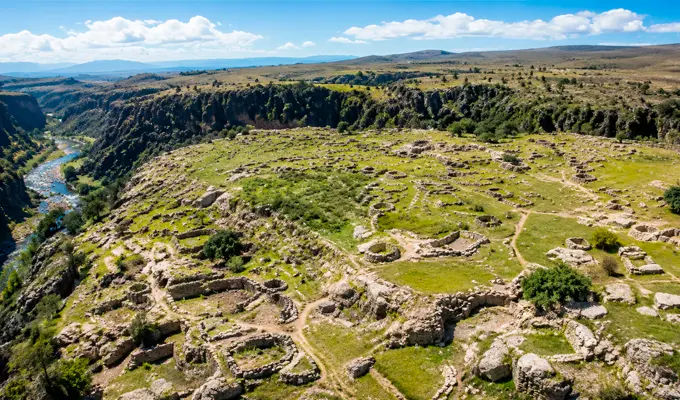
Archaeological excavations at T’aqrachullo have begun to uncover secrets that completely reshape what we thought we knew about this site, revealing the immense political and religious significance it held during pre-Hispanic times.
Among the most fascinating discoveries are valuable ceremonial objects and finely crafted ornamental pieces made from precious metals such as gold, silver, and copper, along with a variety of structures built exclusively for ritual activities.
These remarkable findings further strengthen a theory that is gaining increasing support among researchers: Taqrachullo was far more than a simple defensive fortress or isolated military refuge. Instead, this complex played a fundamental role within the sacred and administrative organization of the Inca Empire (Tahuantinsuyo).
The great mystery that continues to intrigue researchers and surrounds T’aqrachullo with an almost cinematic aura is its possible hidden identity: Are we truly standing on the grounds of the legendary Ancocagua?
This fascinating question takes us back to the pages of early colonial chronicles. In these accounts, the first Spanish chroniclers described an imposing Inca sanctuary and ceremonial center known by that name, inspiring both deep respect and awe. For centuries, archaeologists and historians have searched for the precise location of this mythical sacred city, attempting to pinpoint where it once stood.
Today, the pieces of the puzzle are beginning to fall into place. Several renowned researchers firmly believe that T’aqrachullo could, in fact, be this long-lost ancient city. The evidence is compelling: its magnificent elite architecture, its exceptional strategic location, and the unmistakable ceremonial significance reflected in its stone structures. However, in the world of science, conclusions are reached with patience. Excavations and research continue at the site, and although the clues are highly promising, there is still no definitive confirmation to solve the mystery. Until then, the fortress continues to guard its secret.
During the colonial period, the encounter of two worlds transformed not only the lives of local communities but also the maps themselves. Many of the great Andean archaeological sites were given new names by the Spanish, who often sought to rename the territory according to their own traditions.
It was during this period of cultural blending that the original Quechua name began to share its identity. Over time, T’aqrachullo came to be popularly known as María Fortaleza. This name, which combines a sense of religious mysticism with admiration for the site's imposing engineering, has endured through the centuries. Today, it is still widely used by local residents, researchers uncovering its past, and travelers who come to discover its wonders.
Today, both names coexist in perfect harmony. Whether you call it T’aqrachullo or María Fortaleza, both refer to the very same archaeological complex a monumental stone fortress in the highlands of Espinar that preserves one extraordinary history under two different names.
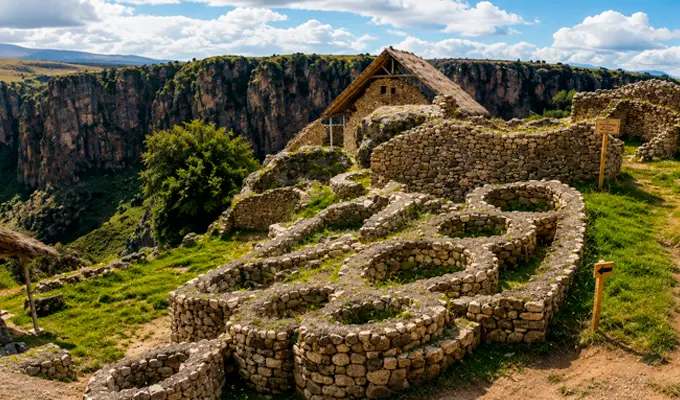
Reaching this Andean mystery requires embarking on a true journey of exploration. The mystical citadel is located in the province of Espinar, in the southern part of the Cusco region. The journey usually begins in the vibrant city of Cusco, following a scenic road toward the district of Suyckutambo.
One of the greatest rewards of this trip is that the journey itself becomes part of the adventure. Along the way, travelers can immerse themselves in breathtaking natural scenery while combining their visit to the fortress with several nearby attractions:
Thanks to the extensive restoration and conservation efforts carried out in recent years, this remarkable archaeological complex is becoming increasingly accessible, safer to visit, and better prepared to welcome both domestic travelers and international explorers looking to venture beyond Peru’s traditional tourist destinations.
While iconic destinations such as Machu Picchu continue to captivate the world as Peru’s greatest symbol, T’aqrachullo is steadily emerging as a remarkable destination in its own right. This monumental stone complex is becoming the perfect alternative for adventurous travelers eager to discover places untouched by mass tourism and rich in profound, silent history.
It is a true hidden gem. Its combination of monumental architecture, breathtaking natural landscapes, unresolved historical mysteries, and vibrant cultural heritage makes it, without question, one of the archaeological projects with the greatest tourism potential in the southern Andes. Taqrachullo stands as living proof that beyond Peru’s well-known routes, the Andes still hold extraordinary secrets waiting to be discovered.